Laurel River turned the Dubai World Cup into a procession when running out a wide-margin winner for local trainer Bhupat Seemar and jockey Tadhg O’Shea.
This is The Marshall Project’s Closing Argument newsletter, a weekly deep dive into a key criminal justice issue. Want this delivered to your inbox? Subscribe to future newsletters here.
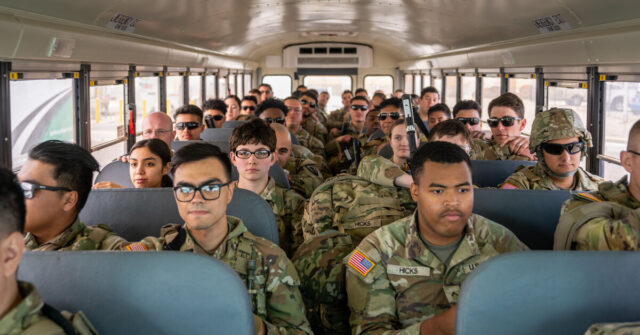
Close to 200 National Guard soldiers and state police officers from Iowa, Indiana and Nebraska are preparing to deploy to the southern border in Texas, as a bitter partisan battle over immigration enforcement roils, and as the border itself becomes increasingly militarized. According to Newsweek, at least 14 states have sent soldiers since 2021, all on the order of Republican governors.
The personnel have been dispatched to assist with Texas Gov. Greg Abbott’s Operation Lone Star, an effort to police the border with state resources on the premise that the federal government has failed to do so effectively. The plan has included the deployment of thousands of national guardsmen, the erection of floating barriers and concertina wire, and roughly 40,000 criminal arrests (mostly for trespassing on private property). It has also created a testy ongoing standoff with federal agents at a high-volume crossing location in Eagle Pass, about two hours southwest of San Antonio.
Texas and the federal government are also facing off in court, where this week, the Fifth Circuit Court of Appeals froze a law signed by Abbott that would make it a state crime to cross the border illegally. Were it to take effect, SB 4 would dramatically increase the state’s legal authority to criminally prosecute migrants, essentially creating a parallel immigration law system, complete with Texas-run deportations. Even the very conservative Fifth Circuit has been reluctant to contradict the vast body of law that delegates sole immigration enforcement powers to the federal government.
“For nearly 150 years, the Supreme Court has held that the power to control immigration — the entry, admission, and removal of noncitizens — is exclusively a federal power,” wrote Chief Judge Priscilla Richman.
The rapidly evolving status of the law — last week, different courts unpaused and re-paused its enforcement within a matter of hours — has left many confused, migrants and lawyers alike. Adam Isacson, director for defense oversight at the Washington Office on Latin America, a human rights nonprofit, told The New York Times that even unenforced, the law is prompting some migrants to try to cross the southern border in other states. Other experts note that Mexican authorities are changing enforcement strategies, which may also be driving down Texas crossings.
In addition, Tennessee and Georgia both passed related bills this week, bolstering the requirements for local police to inform federal immigration officials about undocumented persons. According to sponsors of the Georgia law, the effort was prompted by the death of Laken Riley, a 22-year-old nursing student who was killed while out for a jog in February. Authorities have said that Jose Antonio Ibarra, who has been charged with Riley’s murder, is a Venezuelan asylum-seeker who had previously been arrested and released in New York and Georgia.
According to an Associated Press-NORC Center for Public Affairs Research poll released on Thursday, Americans are increasingly concerned about immigrants — both legal and illegal — committing crimes. The same poll found that “substantial shares of U.S. adults believe that immigrants contribute to the country’s economic growth, and offer important contributions to American culture.”
This national tension plays out in Fremont, Nebraska. An influx of (frequently undocumented) migrants has kept the town’s three meat-processing plants in business, as young American-born residents have left for higher-paying, less dangerous work. But the town also has a 15-year-old law requiring anyone renting a property to sign a declaration that they are legally present in the U.S.
And in Baltimore this week, the collapse of the Francis Scott Key Bridge offers a tragic reminder of the role of immigrant labor in the U.S. economy. All six of the people presumed dead in the collapse were migrants from Latin America doing road maintenance on the bridge.
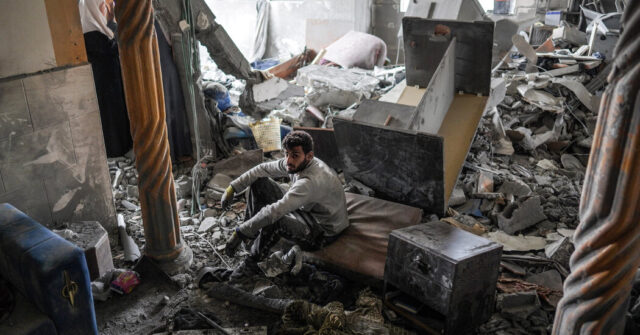
The huge rear gate of the Jordanian air force cargo plane slowly lowers like a stiff iron jaw, revealing a hazy blue sky and, far below, the battered landscape of northern Gaza.
Inside the plane’s cavernous hold, the aid being delivered by the crew is lined up in neat rows: chest-high bundles of boxes stacked atop wooden pallets, each one bound by shrink-wrap and heavy straps and marked with images of Jordan’s flag.
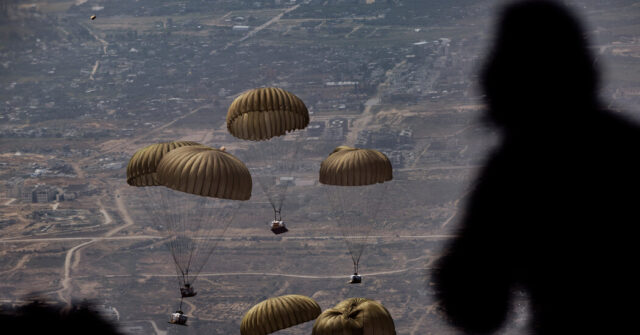
Now, as the light and the sound rush in, the bundles slide down rollers in the floor and disappear out the door, floating down under billowing parachutes as a silent, and most likely inadequate, offering to the desperate population below.
With humanitarian groups and others sounding the alarm over a looming famine in northern Gaza and hunger widespread throughout the territory, airdrops are playing a prominent role in efforts to deliver food, water and urgent supplies to Palestinians.
On Thursday, the Jordanian air force allowed a photographer for The New York Times on one of its planes to observe the airdrop of bundles of aid across northern Gaza. The trip, taking off and returning from Jordan’s King Abdullah II air base, east of Amman, took several hours.
Countries including Jordan, the United States, Britain and France say the drops are helping compensate for a steep fall in the amount of aid entering Gaza by truck since Oct. 7, when Hamas led a deadly attack on Israel, and Israel responded with a monthslong military assault.
The United Nations and aid groups have complained that deliveries by truck are being slowed by Israel’s insistence on inspecting all supplies going into Gaza. Most aid trucks have been allowed in through just two border crossings — one from Egypt and one from Israel — in southern Gaza.
Israel has maintained that disorganization among aid groups is responsible for slow deliveries of aid to Palestinians and that much of the aid is diverted to Hamas or the black market, though it is not possible to verify those claims.
One of the few alternatives is dropping supplies from the sky, a process that takes only minutes in the air but extensive bureaucracy and hours of preparation on the ground.
The dozens of pallets pushed out of the planes on Thursday included thousands of meals, the Jordanians said. But airdrops are inefficient and expensive, humanitarian officials say, with even big military cargo planes delivering less than a single convoy of trucks could.
And the airdrops can be dangerous: This week, Gazan authorities said 12 people drowned while trying to retrieve assistance that had fallen into the ocean.
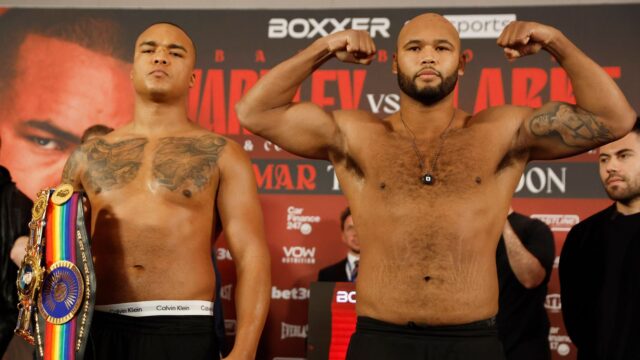
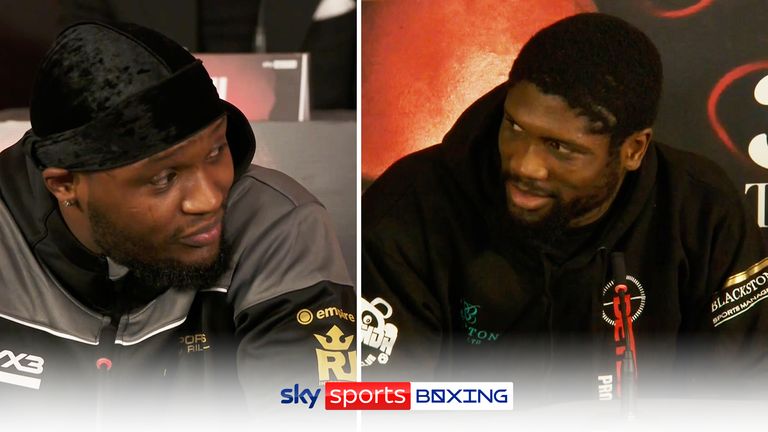
Fabio Wardley and Frazer Clarke have taken to the scales ahead of their British and Commonwealth title fight on Sunday, live on Sky Sports.
Wardley and Clarke headline a big bill at The O2 arena in London with two titles and their heavyweight pride on the line.
At the weigh-in, Clarke was the bigger man by 23lbs, 19st to the champion’s 17st 5lbs.
Please use Chrome browser for a more accessible video player
Boxing journalist John Dennen told Andy Scott that Wardley and Clarke carry real power and will have explosive moments on Sunday night
That, though, is the lightest Clarke has been since his professional debut, a hint at his application ahead of this fight.
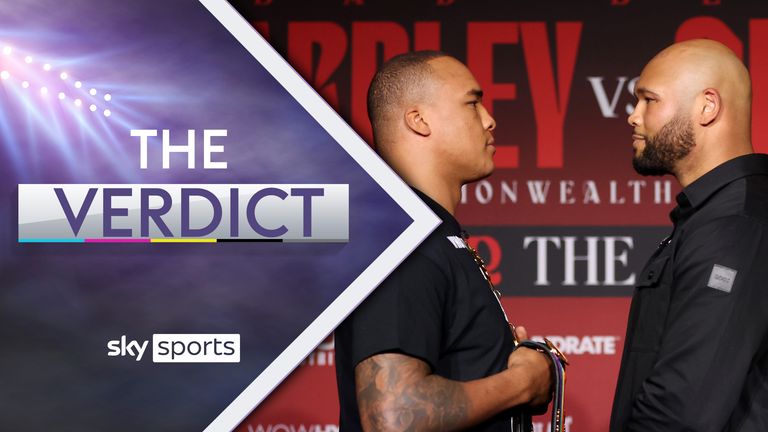
In their head-to-head Clarke glared at his opponent while Wardley gazed levelly back before looking out to the assembled crowd.
“The weight is irrelevant and I’ve done my job and I’m ready to go,” Clarke said. “I know what’s coming.
“I’m going to knock him out and then I’m going to laugh at his team.”
Wardley chuckled: “He’s paying too much attention to everything around him. I’m not fussed about him.”
In his view: “There’s thinking moments and there’s heart moments and who’s really got it in him and we’re going to find out on Sunday.
“You’re going to get an action-packed fight. And I’m always going for that big knockout.”
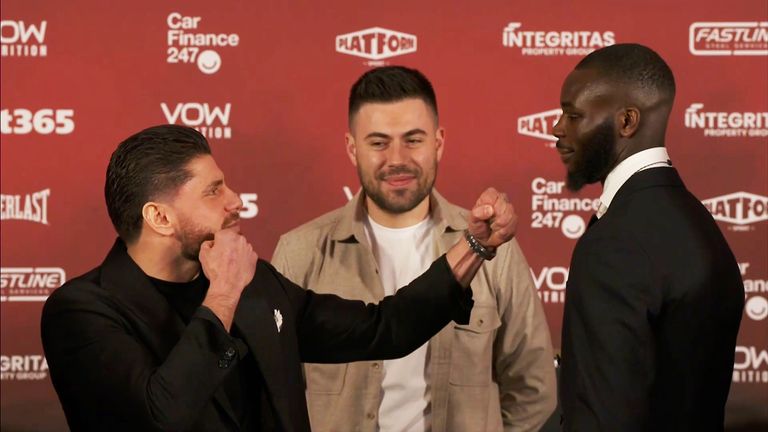
For his intense grudge match with Florian Marku, Chris Kongo weighed 10st 6lbs 5oz. ‘Albanian King’ Marku was 10st 6lbs.
Please use Chrome browser for a more accessible video player
Florian Marku squared up to Chris Kongo in a fighting stance and tried to intimidate him at the press conference head-to-head
The two fighters had to be prised apart by security.
“My message is to all opponents who disrespect me, they are going to pay,” Marku roared. “He is going to pay.
“This guy tomorrow, he’s going to be shaking because he’s a coward. I’m going to show tomorrow who I am.”
Kongo composed himself quickly. “We got him,” he said. “Nobody is going to save him tomorrow.
“When I knock him down, he won’t survive. Let’s go.”
He shrugged off Marku’s vociferous support, saying: “Crowds don’t win fights. Fighters win fights and I’m a real fighter. He’s not.”
Please use Chrome browser for a more accessible video player
Viddal Riley told Mikael Lawal that he has faced bigger punchers and won’t be running scared on Sunday night
Viddal Riley takes on Mikael Lawal in a high-stakes English cruiserweight title fight. Both made the weight, Lawal 14st 2lbs and Riley five ounces heavier.
“I’m going to come for him and I’m going to knock him out,” a highly-motivated Lawal said.
Riley shrugged off that claim. “He has to feel that way,” the champion said. “Tomorrow we show what we can do to bullies.
“I’m an elite athlete and an elite boxer.”
Ben Whittaker packed his lean frame into 12st 9lbs. His opponent Leon Willings, who has won a Central Area title (not on the line in this fight) and has only lost once in his career, was five ounces heavier.
Please use Chrome browser for a more accessible video player
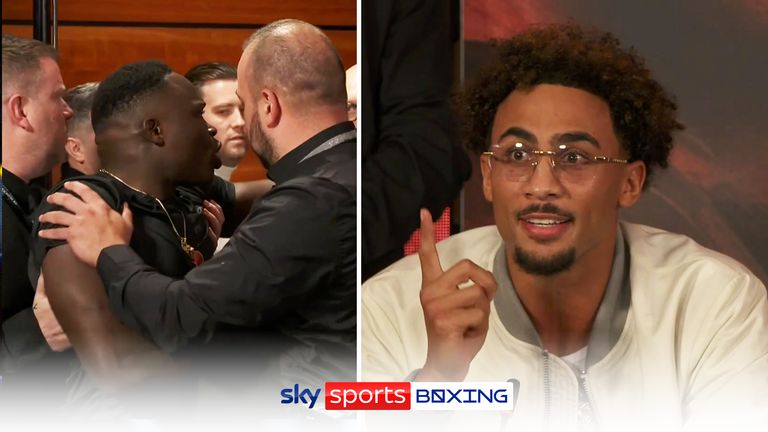
Security had to restrain Nigerian contender Ezra Arenyeka who stormed towards the stage to challenge Ben Whittaker
After a long face-off, they exchanged words. “Ben’s a big character, but I’m just going with the flow, ready for tomorrow,” Willings said. “It’s a big moment, a huge moment, I’m ready to go.”
Whittaker is now renowned for his showboating. But he suggested “surgery” could be in the offing for Willings. “Maybe I just go out there and really just break him down,” he said.
His prediction: “Another beatdown, that’s what it is.”
Callum Simpson (11st 13lbs) hopes to continue his super-middleweight rise against Dulla Mbabe (12st 1lbs).
He will hope to capture some of the limelight at The O2 on Sunday.
“I want to get in there and get rid of him,” Simpson said. “This fight I want to show that I’m explosive, I’ve got that power.”
Please use Chrome browser for a more accessible video player
Alen Babic reacted furiously when Steve Robinson challenged him at the press conference and vowed to end his career
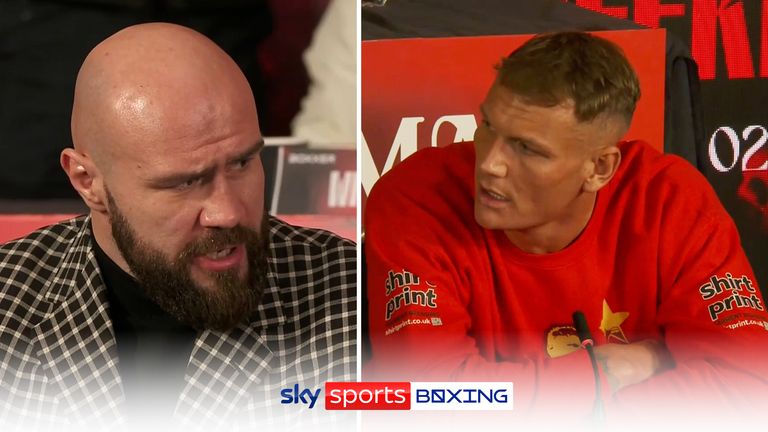
Steve Robinson (17st 1lbs) looked down on Alen Babic (15st 7lbs 5oz) when they went nose to nose for a stony face-off ahead of their heavyweight contest that will open the show on Sunday.
“I will give him everything he wants,” Babic warned. “I’m going to steal the show and I plan to do just that.”
“It’s chaos,” Robinson reckoned of their fight. “What matters is you’ve got two people in the centre of the ring and he’s getting knocked out.
“First round!”
Don’t miss Wardley vs Clarke this Sunday live on Sky Sports.
Although the United Nations Security Council passed a resolution on Monday that demands an immediate cease-fire in the Gaza Strip, it remains to be seen whether it will have a concrete effect on the war or prove merely to be a political statement.
The measure, Resolution 2728, followed three previous attempts that the United States had blocked. It passed by 14 votes, after the United States abstained from voting and did not employ its veto.
The resolution also calls for the unconditional release of all hostages and the end to barriers to humanitarian aid.
Israel’s government condemned the vote, and early indications are that the U.N.’s action has changed little on the ground or spurred diplomatic progress.
Days after the vote, here’s a look at what has changed and what might happen next:
Has the resolution affected fighting?
Senior Israeli officials said that they would ignore the call for a cease-fire, arguing that it was imperative to pursue the war until it has dismantled the military wing of Hamas, the militant group that led the Oct. 7 attack on Israel.
Israel’s military is pressing on with a raid at Al-Shifa Hospital in northern Gaza, the territory’s biggest medical facility, as well as its offensive in Khan Younis, the largest city in the south, where fighting has been fierce.
An explosion during strikes in Rafah on Tuesday night.Credit…Said Khatib/Agence France-Presse — Getty Images
If Israel doesn’t heed the resolution, what can the U.N. do?
The Security Council has few means to enforce its resolutions. The Council can take punitive measures, imposing sanctions against violators. In the past, such measures have included travel bans, economic restrictions and arms embargoes.
In this case, however, legal experts said that any additional measure would require a new resolution and that passing it would require consent from the council’s five veto-holding members, including the United States, Israel’s staunchest ally.
There may be legal challenges as well. While the United Nations says that Security Council resolutions are considered to be international law, legal experts debate whether all resolutions are binding on member states, or only those adopted under chapter VII of the U.N. charter, which deals with threats to peace. The resolution passed on Monday did not explicitly mention Chapter VII.
U.N. officials said it was still binding on Israel, but some countries disagreed. South Korea said on Monday that the resolution was not “explicitly coercive under Chapter VII,” but that it reflected a consensus of the international community.
Crucially, the U.S. ambassador to the United Nations, Linda Thomas-Greenfield, maintained that the resolution was nonbinding. The United States, which holds significant power on the Security Council because of its permanent seat, likely views the passage of the resolution as more a valuable political instrument than a binding order, experts said.
The U.S. abstention sends a powerful signal of its policy priorities even if, in the short term, the Security Council is unlikely to take further steps, according to Ivo H. Daalder, a former American ambassador to NATO.
“Neither Israel or Hamas is going to be swayed by a U.N. resolution,” Mr. Daalder said.
What about aid?
Israel controls the flow of aid into Gaza, and after five months of war, Gazans are facing a severe hunger crisis bordering on famine, especially in the north, according to the United Nations and residents of the territory.
Aid groups have blamed Israel, which announced a siege of the territory after Oct. 7. They say officials have impeded aid deliveries through inspections and tight restrictions.
Israel argues that it works to prevent aid reaching Hamas and says that its officials can process more aid than aid groups can distribute within the territory. Growing lawlessness in Gaza has also made the distribution of aid difficult, with some convoys ending in deadly violence.
Little has changed this week. The number of aid trucks entering Gaza on Tuesday from the two border crossings open for aid roughly matched the average daily number crossing this month, according to U.N. data. That figure, about 150 trucks per day, is nearly 70 percent less than the number before Oct. 7.
Aid airdropped over Gaza on Wednesday.Credit…Jack Guez/Agence France-Presse — Getty Images
How has the resolution affected diplomacy?
Israel and Hamas appear to still be far apart on negotiations aimed at brokering a halt in fighting and an exchange of hostages for Palestinian prisoners.
Mediators have been in Qatar to try to narrow the gaps. But late Monday, Hamas rejected Israel’s most recent counterproposal and its political leader, on a visit to Tehran this week, said the resolution showed that Israel was isolated diplomatically.
Prime Minister Benjamin Netanyahu of Israel has argued that the resolution set back negotiations, emboldening Hamas to hold out for better terms.
The biggest sticking point in the cease-fire talks had recently been the number of Palestinian prisoners to be released, in particular those serving extended sentences for violence against Israelis, U.S. and Israeli officials have said.
Sheffield United are eight points from safety with 10 games remaining and as the Blades fight to stay in the Premier League, Sky Sports News senior reporter Tim Thornton sat down with striker Oli McBurnie, who revealed an even bigger personal battle his family are facing away from football.
Oli, it’s three weeks since the last Premier League game, has it given you an opportunity to reset physically and mentally?
Image: Oliver McBurnie says it has been good to get away from football in the international break
Definitely, I think, especially on the mental side, I think it was important that the boys got out of the building for a little bit and just kind of reset with the families or whatever they needed to do. We were all sick of seeing each other for a little bit, so, yeah, nice to have a little bit of time off, and then the last couple of weeks, get some good training in, and I feel like the boys are all rejuvenated and ready to go.
What has it been like from a mental perspective this season because you’ve taken a lot of hits? Is it difficult to get away from football and switch off?
Yeah, definitely. To get to the level that we’ve got to in football, you have to kind of be obsessive about football. The boys were winners, really, the boys were winners, so to have a season where you’re losing so much, it really hurts. It’s very difficult to just switch off from it and go about your normal life, but boys have different ways of trying to do it. I’m not very good at it, I’ll be honest. There are times where, after a game, my missus will know just to leave me alone for the day or whatever, just get through it myself and kind of forget about it as much as I can. I’ll be just staring at a wall, thinking about things that I could have done differently in the game, all that sort of stuff.
You become a dad this summer, so will that be a good distraction for you moving forward?
Yes, in June, our little daughter comes along, so that will give me plenty to distract myself from football, I’m sure everyone keeps telling me. I’m excited for that and ready for it now.
You’ve become a leader in the group this season. Does it feel quite strange to be one of the older statesmen in the dressing room?
This is the first season where I probably have to accept the fact that I am one of the older boys.
I’ve had managers that have told me that I am quite a leader in the changing room and to draw on that more and to try and excel in that area more. I think it’s become a natural progression.
I was never quiet or short of confidence or shy when I was younger, and I’ve moulded that into a bit more of a positive thing. I remember coming through as a young boy and there were always older boys that helped you and older boys that you weren’t too fond of. I wanted to be one of the ones that the young boys looked up to and thought he was good for me and helped me at the beginning.
Has it become even more important this season? Because John Egan’s been injured, and Chris Basham got injured down at Craven Cottage earlier in the season. And they’re two senior players who have a big influence here.
Please use Chrome browser for a more accessible video player
FREE TO WATCH: Highlights from the Premier League clash between Bournemouth and Sheffield United
Yes definitely, in the summer that’s one of the things that we lost.
A few of the boys that had left, you look at Sharpy [Billy Sharp], Enda Stevens, Jack O’Connell, these boys that are real experienced boys and then obviously we’re losing Egan and Basham at the start of the season, which was tough. It kind of fell down a little bit more to the boys that were still there and were still fit. So yes, I think it has increased this season.
Obviously, Bash’s injury and Bash coming back into training every day has given the boys a big boost. Seeing him in and around the place, you know how much energy he brings and even when he’s not playing, how much of a boost he can give the boys.
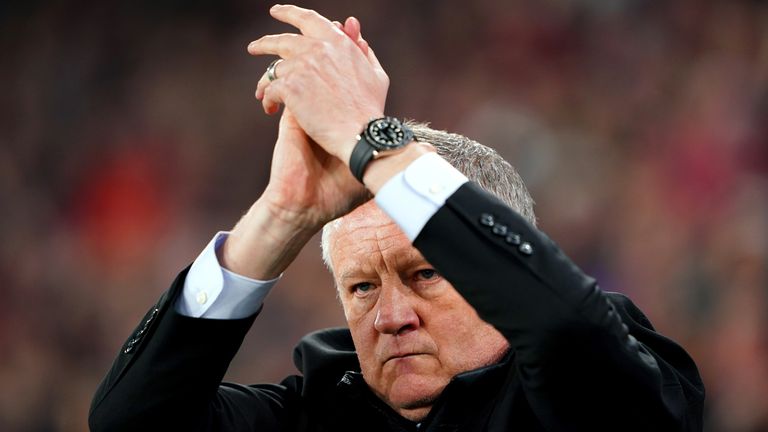
Chris Wilder, in charge again now. He signed you here at Sheffield United. Has it been strange him coming back for a second spell or has it felt quite natural because you had that connection from the first time you were here?
Yes, it definitely felt quite natural.
The gaffer has been unbelievable with me. My little brother, about two months ago, got diagnosed with Hodgkin’s lymphoma, so it’s a cancer. He’s going through chemotherapy right now.
That’s why I shaved my hair off with him. I said when his hair falls out, I’ll shave it off with him. But as soon as the gaffer found out, he’s been excellent.
Do you need this, or do you need to go see him? Whatever you need, just come and speak to me?
For me, I don’t need that. I want to be at football. I need that kind of thing as the distraction.
But for me personally, Chris Wilder, he’s been so good for me. The first spell, this spell, every time.
But having the gaffer there and the things he does for the boys, a lot of people will never see those things. The boys were all buzzing to see him come back. Obviously, everyone had a lot of respect and appreciation for the things he did for us and got us to where we’ve been.
But for me personally, Chris Wilder, he’s been so good for me. The first spell, this spell, every time.
We see you as Oli McBurnie, the footballer, but you just mentioned your brother there. We don’t always know what’s going on behind the scenes. Has it been really tough?
Of course, it’s tough.
It was a real out-of-the-blue thing. My brother’s 26, a professional footballer at the time. He just gets a lump in his neck, has a few tests, and all of a sudden, he’s got cancer.
But it’s not like anything can change for me. I’ve still got to come into work every day. I’ve still got to go about my normal day-to-day life.
There are obviously things that people don’t get to see. We don’t like to always go through stuff all the time.
We don’t want to shout about things. It’s just one of those things. Being a footballer, you’ve got to get on with it and do your job the same as everyone else does.
Ten games to go. It’s obviously a very difficult situation, but not impossible?
Image: Oli McBurnie still believes the Blades can stay up this season
Yes, not impossible. There’s always that glimmer of hope if you pick up a few results.
We’re not dreamers. We know we’ve put ourselves in a very difficult situation. But when I speak to the boys about it, there’s nothing to lose, really.
We’re bottom of the league, so it can’t get much worse in terms of that. Go out and play without that pressure and see what happens.
So, we’ll keep going because we know strange things can happen in football.
Days after Hamas launched its Oct. 7 attacks on Israel, Germany’s chancellor, Olaf Scholz, was one of the first Western leaders to arrive in Tel Aviv. Standing beside the Israeli prime minister, Benjamin Netanyahu, he declared that Germany had “only one place — and it is alongside Israel.”
That place now feels increasingly awkward for Germany, Israel’s second-largest arms supplier and a nation whose leadership calls support for the country a “Staatsräson,” a national reason for existence, as a way of atoning for the Holocaust.
Last week, with Israel’s deadly offensive continuing in Gaza, the chancellor again stood next to Mr. Netanyahu in Tel Aviv, and struck a different tone. “No matter how important the goal,” he asked, “can it justify such terribly high costs?”
With international outrage growing over a death toll that Gazan health authorities say exceeds 32,000, and the looming prospect of famine in the enclave, German officials have begun to question whether their country’s support has gone too far.
“What changed for Germany is that it’s untenable, this unconditional support for Israel,” said Thorsten Benner, director of the Global Public Policy Institute in Berlin. “In sticking to this notion of Staatsräson, they gave the false impression that Germany actually offered carte blanche to Netanyahu.”
Berlin’s hardening tone is partly a response to fears over Israel’s continued insistence that it must enter Rafah in order to pursue Hamas operatives it says are in the southern Gazan city. The change in stance also tracks with the evolving position of Germany’s most important ally, the United States, which has shown increasing displeasure with Israel’s actions, including through an abstention in a U.N. Security Council vote that allowed a cease-fire resolution to pass.
The change in the German stance has made itself felt in a matter of weeks.
In January — just months after the Hamas-led attacks that Israeli officials say killed some 1,200 people — Germany intervened in defense of Israel against South Africa’s charges of genocide at the International Court of Justice. It cited Germany’s history to position itself as a kind of moral authority when it came to backing the convention against genocide and defended Israel against growing criticisms of its handling of the war.
As recently as last month, Mr. Scholz resisted answering questions at the Munich Security Conference about whether Israel had violated international humanitarian law.
But this week, Germany’s foreign minister, Annalena Baerbock, said she would be sending a delegation to Israel because as a signatory to the Geneva Conventions, her country “is obliged to remind all parties of their duty to abide by international humanitarian law.”
During a visit to the region, her sixth since the attack, Ms. Baerbock also described the situation in Gaza as “hell” and insisted that a major offensive on Rafah, where more than a million people have sought shelter, must not happen.
“People cannot vanish into thin air,” she said.
Israel’s foreign minister, Israel Katz, responded to Ms. Baerbock’s criticisms in a statement on social media, saying, “We expect our friends to continue supporting Israel during these challenging times and not weaken it against the terrorist organization Hamas.”
Berlin, like Washington, has tried to position itself as a concerned friend, intent on ensuring Israel’s long-term security by not allowing it to go so far that it loses even more international backing. But the stakes are high for Germany, too.
The country needs to maintain friendly relations around the world to pursue its own interests, whether Europe is cutting deals with Egypt to curb migration or seeking support for measures to back Ukraine against Russia. Foreign-policy experts say that by hewing to its strong support of Israel, Germany has also undermined its ability to credibly criticize authoritarian governments like that of Russia’s Vladimir V. Putin for human rights violations.
The sense of diminishing credibility on human rights is particularly strong in the set of developing or underdeveloped countries sometimes referred to as the Global South, a point brought home during a visit to Berlin this month by Malaysia’s prime minister, Anwar Ibrahim.
“We oppose colonialism, or apartheid, or ethnic cleansing, or dispossession of any country, be it in Ukraine, or in Gaza,” Mr. Anwar told journalists as he stood beside Mr. Scholz. “Where have we thrown our humanity? Why this hypocrisy?”
Until recently, German public opinion seemed firmly behind the government’s support of Israel’s military campaign. But polls by public broadcasters in recent weeks show that nearly 70 percent of Germans surveyed felt Israel’s military actions were not justifiable; just a few weeks earlier, the number was around 50 percent.
The matter has become inescapable for Mr. Scholz even in town-hall sessions with voters.
“I find Germany’s foreign policy contradictory, and even hypocritical,” one woman told Mr. Scholz in the town of Brandenburg an der Havel, outside Berlin, earlier this week.
On the one hand, she said, Germany was calling on Israel not to invade Rafah. On the other, Germany remained one of Israel’s biggest arms suppliers. “We have to really do something to protect these people,” she said.
Berlin’s toughened stance over the war is unlikely to indicate any broader turn against Israel. This week, the Interior Ministry said it would include questions about Israel in an updated citizenship test, a reflection of how strongly Germany sees support of Israel as part of its own identity.
And beyond a change in tone, there is little Berlin is likely to do that is not symbolic, policymakers say, unless Washington takes tougher measures. In a written reply to a question from a lawmaker, Sevim Dagdelen, on whether Germany would stop arms deliveries, the government said it would consider them on a “case by case” basis.
The most important decision it could make, said Jürgen Hardt, the foreign policy spokesman for the center-right Christian Democrats in the Parliament, was to restore funding to the main U.N. agency aiding Palestinians, UNRWA. In the wake of allegations that some of the agency’s employees participated in the Oct. 7 attack or its aftermath, Germany said it would suspend the funding. (U.N. officials said they had fired 10 of the 12 employees initially accused and had ordered an investigation into the agency, while imploring nations that suspended aid payments to reconsider.)
Now, Germany appears to be changing its position. This week, Germany said it would again fund the agency in the areas where it operates outside Gaza.
Weeks earlier, German diplomats sought the removal of the head of UNRWA, Philippe Lazzarini, as a precondition to restore funding, according to German and European Union officials familiar with the situation.
But the same officials said they had observed a marked softening of Germany’s stance since then, and that the Germans appeared to have abandoned the request that Mr. Lazzarini be replaced. E.U. and German officials said Germany was likely to release funding for Gaza operations by May.
“That could be one small action,” Mr. Benner, the foreign policy analyst, said. “But I think the damage is already done in terms of German credibility. Now, it’s a mission of damage control.”
Matina Stevis-Gridneff contributed reporting from Brussels.
Officials have accused Alice Guo of helping criminal syndicates involved in online scams and human trafficking, and have questioned her about whether she...