
Home Blog Page 302

Russia Amps Up Online Campaign Against Ukraine Before U.S. Elections

0

[ad_1]

Russia has intensified its online efforts to derail military funding for Ukraine in the United States and Europe, largely by using harder-to-trace technologies to amplify arguments for isolationism ahead of the U.S. elections, according to disinformation experts and intelligence assessments.

In recent days, intelligence agencies have warned that Russia has found better ways to hide its influence operations, and the Treasury Department issued sanctions last week against two Russian companies that it said supported the Kremlin’s campaign.

The stepped-up operations, run by aides to President Vladimir V. Putin and Russian military intelligence agencies, come at a critical moment in the debate in the United States over support for Ukraine in its war against Russia. While opposition to additional aid may have started without Russian influence, the Kremlin now sees an opportunity.

Russian operatives are laying the groundwork for what could be a stronger push to support candidates who oppose aiding Ukraine, or who call for pulling the United States back from NATO and other alliances, U.S. officials and independent researchers say.

Investigators say that firms working in the “Doppelgänger” network — and Russian intelligence agencies duplicating the tactics — are using the techniques to replicate and distort legitimate news sites in order to undermine continued aid to Ukraine.

These techniques are subtle and far more skillful than what Russia attempted in 2016, when it made up Facebook posts or tweets in the names of nonexistent Americans, and used them to fuel protests over immigration or other hot-button issues.

The loosely linked “Doppelgänger” creates fake versions of real news websites in the United States, Israel, Germany and Japan, among other countries. It often promotes websites previously associated with Russia’s military intelligence agency, known as the G.R.U.

The result is that much of the original speech is First Amendment-protected — say a member of Congress declaring that resources being sent to Ukraine should instead be used to patrol the southern border of the United States. But the amplification is engineered in Russia or by Russian influencers.

Mr. Putin has given responsibility for a growing number of influence operations to a key lieutenant, Sergei Kiriyenko, according to American and European officials. The Treasury Department last Wednesday imposed sanctions on people associated with Mr. Kiriyenko’s operations.

Researchers at Alethea, an anti-disinformation company, have identified a group affiliated with the G.R.U. that is using hard-to-detect techniques to spread similar messages on social media. A report by Alethea echoed a recent assessment by American intelligence agencies that said Russia would continue to “better hide their hand” while conducting influence operations.

“The network demonstrates an evolution of Russian objectives with their information operations,” Lisa Kaplan, the firm’s founder and chief executive, said in an interview. “Where the Russians previously sought to sow chaos, now they appear to be singularly focused on influencing democracies to elect candidates that do not support sending aid to Ukraine — which in turn supports isolationist, protectionist candidates and policies.”

“This long-term strategy, if effective, would result in reduced support for Ukraine globally,” she said.

American officials note, however, that these techniques make identifying — and calling out — Russian operations particularly difficult.

In the 2016 election, the Internet Research Agency, a Russian troll farm that waged information warfare against the United States, spewed out thousands of social media posts, pretending they were from Americans. By the 2020 election, the National Security Agency learned how to disrupt the operations inside Russia.

Moscow moved to shut down the Internet Research Agency after its founder, Yevgeny V. Prigozhin, staged a short-lived mutiny against the Russian military last year. People affiliated with the group remain active. But U.S. officials and experts say it is no longer the main Russian influence effort.

“The Internet Research Agency in many ways was just a place holder for what became a much more expansive information effort in traditional media and social media,” said Clint Watts, the general manager of Microsoft’s Threat Analysis Center.

The latest efforts are more directly controlled by the Kremlin. Before the Treasury sanctions last week, the State Department outlined what it said were efforts by the two Russian companies, the Social Design Agency, a public relations company, and Structura National Technologies, an information technology firm, to create disinformation campaigns.

American intelligence agencies do not believe the Kremlin has begun its full-bore influence effort. Mr. Putin will probably shift at some point from the anti-Ukraine messaging to influence operations that more directly support the candidacy of former President Donald J. Trump, the presumptive Republican nominee.

Mr. Putin is not likely to order a major effort in the presidential election until after the party conventions this summer, officials and experts said.

“What we’ve observed is the Russians, and a number of other adversarial countries, thinking about how and when they might influence the election,” said Jim Himes, Democrat of Connecticut and a senior member of the House Intelligence Committee.

Mr. Putin argues that the United States has sought to influence Russian politics, including the presidential election this month, in which he was, unsurprisingly, re-elected by an overwhelming margin. It is not clear how much Mr. Putin regards U.S. sanctions issued after the death of the opposition leader Aleksei A. Navalny as a kind of interference in his politics.

“Putin believes in his heart that we meddle in his elections,” Mr. Himes said. “Things like contact with dissident groups or amplifying Navalny’s message. Putin sees all of that as interference on the part of the U.S. He regards things like senators and congressmen criticizing his election as election interference.”

The Russian activity captivating American attention is not limited to influence operations. Russia’s S.V.R., the intelligence agency that was most active in the 2016 election and that was behind the “SolarWinds” hack that gained entry to scores of government agencies and major American companies, has been in a monthslong attack on Microsoft. The effort appears aimed at gaining access to emails and corporate data.

And U.S. officials say that ransomware attacks continue to surge from Russian territory.

A wave of such attacks prompted President Biden and Mr. Putin’s only leader-to-leader summit, in 2021. An effort to work together on stemming those attacks collapsed as Russia’s invasion of Ukraine began the next year. Today, the hacking campaigns reap millions of dollars for criminal groups, while often serving the Kremlin’s agenda of disrupting American health care, government services and utilities.

In their annual threat assessment, the intelligence agencies said that Russia was trying to sow discord among voters in the United States and its allies around the world, and that the war in Ukraine “will continue to feature heavily in its messaging.”

“Moscow views U.S. elections as opportunities and has conducted influence operations for decades,” the intelligence report said. “Russia is contemplating how U.S. electoral outcomes in 2024 could impact Western support to Ukraine and probably will attempt to affect the elections in ways that best support its interests and goals.”

Russia is likely to be the most active foreign power seeking to influence the presidential election, though China and Iran have also stepped up their efforts, Mr. Himes said.

“It’s important to remember that the nature of election meddling is very different when you’re talking about the Russians,” Mr. Himes said. “The Russians are orders of magnitude more intense and more focused on what we’ve seen from the Chinese, Iranians and others.”

After the 2016 vote, Democrats and Republicans fiercely debated whether Mr. Putin simply wanted to create chaos in the American electorate or actively supported Mr. Trump. The intelligence agencies concluded in that election, and in 2020, that Russia sought to bolster Mr. Trump.

Intelligence agencies believe the Russian government again favors Mr. Trump’s election, largely because of his skepticism about aid to Ukraine. But how explicitly Russian influence operations will support Mr. Trump or denigrate Mr. Biden is unknown, according to American officials.

[ad_2]

Source link
Don't Tell This 'Double-Hater' She's Crazy

0

[ad_1]


Most of those known as ‘double haters’ will come around to support one of the two major party presidential nominees. But some, like Victoria Thompson, won’t back Trump or Biden under any circumstances.

[ad_2]

Source link

Luke Littler, Luke Humphries and Michael van Gerwen headline Poland Darts Masters entry list | Darts News

0

[ad_1]

World champion Luke Humphries, teenage sensation Luke Littler and reigning champion Michael van Gerwen will headline the 16-player field at the Poland Darts Masters.

The World Series of Darts will return to Poland in 2024 at PreZero Arena Gliwice on June 14-15, where eight of darts’ biggest names will take on eight east European darts talents.

Littler, who will face Humphries in the Premier League Darts on Thursday – live on Sky Sports Darts, will make his debut on Polish soil.

The 17-year-old reached the World Championship final at the start of this year before landing a nine-darter on his way to the Bahrain Darts Masters title on his World Series debut.

Littler will be joined in the £60,000 event by Humphries, who currently occupies top spot in the Premier League following a run of three consecutive nightly wins as well as the world number one spot on the PDC Order of Merit.

Please use Chrome browser for a more accessible video player

Luke Littler picks his favourite WWE wrestler as he takes on the Sky Sports ‘Winner Stays On’ challenge.

Reigning Poland Darts Masters champion Van Gerwen produced a string of inspired performances to triumph in Warsaw last year, and the Dutch superstar will bid to continue his remarkable World Series record by going back-to-back in Poland.

Former World Champions Michael Smith, Gerwyn Price and Rob Cross will also feature in Gliwice, alongside 2024 World Matchplay champion Nathan Aspinall.

In addition, two-time World Champion Peter Wright will make his Poland Darts Masters debut after missing out on last year’s inaugural staging due to family commitments.

Please use Chrome browser for a more accessible video player

Michael van Gerwen proves a point to Luke Littler by finishing off the youngster’s nine-darter by hitting a 144.

Poland’s number one Krzysztof Ratajski – a winner of ten PDC ranking titles – will head up the eight east Europe representatives, as he prepares to star on home soil.

Radek Szaganski – a winner on the Players Championship circuit in 2023 – will also make his return, while former UK Open quarter-finalist Sebastian Bialecki will make his World Series debut after winning through the first Polish Qualifier in March.

Czech Tour Card holders Adam Gawlas and Karel Sedlacek have earned a place in the field alongside Croatia’s Boris Krcmar, and the field will be completed with players from a Hungarian Qualifier and a second Polish Qualifier, which both take place in May.

Please use Chrome browser for a more accessible video player

Luke Humphries claimed his third straight Premier League victory after beating Michael Smith in the final in Dublin.

Poland Darts Masters entry list

PDC Representatives

Luke Humphries (England)

  • Michael van Gerwen (Netherlands)
  • Michael Smith (England)
  • Nathan Aspinall (England)
  • Gerwyn Price (Wales)
  • Rob Cross (England)
  • Peter Wright (Scotland)
  • Luke Littler (England)

East Europe Representatives

  • Krzysztof Ratajski (Poland)
  • Radek Szaganski (Poland)
  • Adam Gawlas (Czech Republic)
  • Karel Sedlacek (Czech Republic)
  • Boris Krcmar (Croatia)
  • Sebastian Bialecki (Poland)
  • Polish Qualifier #2
  • Hungarian Qualifier #1

Premier League Darts continues on Sky Sports this Thursday night in Belfast at 7pm on Sky Sports Darts and Main Event. Stream the Premier League Darts on Sky Sports without a contract through NOW

Get Sky Sports on WhatsApp!

You can now start receiving messages and alerts for the latest breaking sports news, analysis, in-depth features and videos from our dedicated WhatsApp channel!

Find out more here…

[ad_2]

Source link

Russia Has No Formal Death Penalty. Here’s How That Might Change.

0

[ad_1]

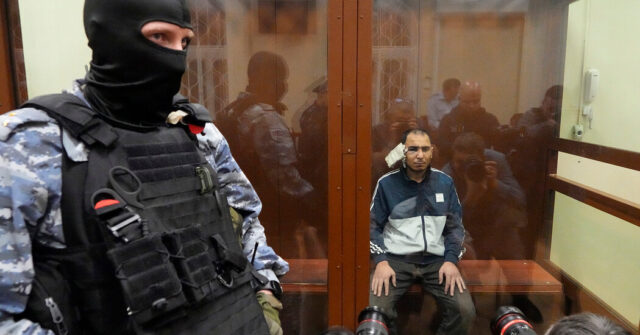
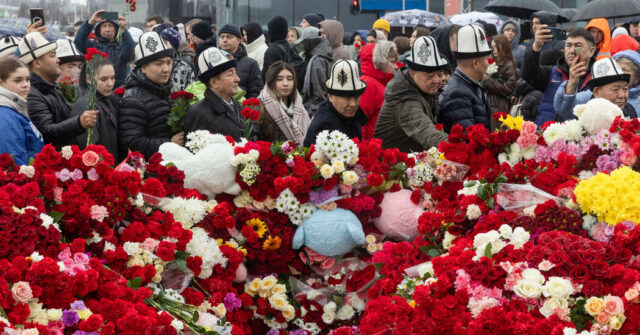
The attack at a concert hall just outside Moscow that killed 139 people last Friday has prompted some Russians to call for bringing back capital punishment in Russia, and to execute the assailants.

Through a combination of presidential action and court rulings, Russia has had a moratorium on the death penalty for 28 years. And yet capital punishment remains on the books — suspended but not abolished outright.

Russian officials disagree on whether and how it could be resurrected, and the country’s Constitutional Court said on Tuesday that it would look into the matter.

Here is a look at where the issue stands.

A number of public figures have demanded execution of the concert hall attackers, described by officials as militant Islamists from Tajikistan, in Central Asia. Such calls have surfaced periodically, particularly after terrorist attacks, but it is not clear how widespread support for them is, and they have prominent opponents, too.

On Monday, Dmitri A. Medvedev, a former president and prime minister of Russia, wrote on Telegram: “Is it necessary to kill them? Necessary. And it will be done.”

He added that everyone who was involved in the attacks, including those who funded and supported them, should be killed.

But Lidia Mikheeva, the secretary of the Civic Chamber, a government advisory group, told the state news agency Tass that ending the death penalty was one of the most important accomplishments in modern Russian history. “If we don’t want to roll back to a time of savagery and barbarism, then we should all stop and think,” she said.

Nothing is likely to change without the say-so of Vladimir V. Putin, the autocratic president who largely controls the Parliament. He has publicly, repeatedly opposed the death penalty in years past.

Mr. Putin and his security apparatus have often been accused of killing or trying to kill his enemies, at home or abroad — journalists, political opponents, business leaders, former spies and others. The opposition leader Aleksei A. Navalny, who survived an assassination attempt with a nerve agent, died last month in a Russian prison system that his allies said had mistreated him and denied him medical care.

And yet in 2002, Mr. Putin said, “as long as it’s up to me, there will be no death penalty in Russia,” though he said reinstating it would be popular. In 2007, he said at a conference that formal capital punishment was “senseless and counterproductive,” according to Russian media reports. In 2022, he said his position “has not changed.”

As for the debate after the concert hall massacre, “We are not currently taking part in this discussion,” said Dmitri S. Peskov, the Kremlin spokesman, according to Tass.

The Soviet Union was one of the world’s most frequent users of capital punishment, and after the country broke up, Russia continued to carry out executions.

But in 1996, to win admission to the Council of Europe, a human rights group, President Boris N. Yeltsin, Mr. Putin’s predecessor, agreed to place a moratorium on the death penalty and to completely abolish it within three years.

Russia’s Parliament did not go along with the plan. It did not ratify the European Convention on Human Rights, which Mr. Yeltsin’s government had signed, and it adopted a new criminal code that kept capital punishment as an option.

In 1999, the Constitutional Court stepped in, ruling that until jury trials were in place across Russia, the death penalty could not be used. In 2009, after jury trials had been instituted, the court ruled the moratorium would remain in effect, abiding by the Council of Europe’s rules, in part because more than a decade without capital punishment had given people an expectation that it would not be used.

“Stable guarantees of the human right not to be subjected to the death penalty have been formed and a constitutional and legal regime has emerged,” the court wrote.

That is unclear.

After Russia invaded Ukraine in 2022, the Council of Europe expelled Russia, meaning Moscow was no longer considered a party to its human rights convention — the original basis for the moratorium.

At the time, Valeriy D. Zorkin, the head of the Constitutional Court, said that bringing back the death penalty back would be impossible without adopting a new Constitution.

“Despite the current extraordinary situation, I think it would be a big mistake to turn away from the path of humanization of legislative policy that we have generally followed in recent decades,” he said in a lecture at the St. Petersburg International Legal Forum. “And, in particular, a rejection of the moratorium on the death penalty in Russia, which some politicians are already calling for, would now be a very bad signal to society.”

But some politicians insisted that without the human rights convention as a barrier, capital punishment could be reinstated without any constitutional change.

That position voiced this week by Vyacheslav V. Volodin, speaker of the Duma, the lower house of Russia’s Parliament. The Constitutional Court, he said, could lift the moratorium.

“Me and you all, we left the Council of Europe, right? Right,” he said.

[ad_2]

Source link

Leftists Have Done the Unthinkable – Driven Me Out of NYC

0

[ad_1]


I’m a born-and-bred New Yorker who never fathomed leaving this city for the boredom of the ‘burbs.

[ad_2]

Source link

Jonathan Haggerty set for outstanding title fight with ‘The Kicking Machine’ Superlek Kiatmoo9 | WWE News

0

[ad_1]

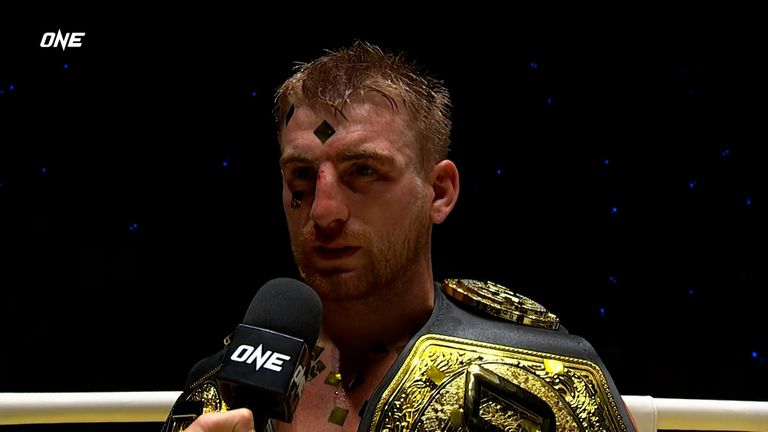
Jonathan Haggerty is set for an outstanding world title defence against Superlek Kiatmoo9, live on Sky Sports.

Haggerty will put his will put his bantamweight Muay Thai world championship on the line against Superlek in a match-up that pits two of the best strikers in the world against one another.

They will fight on September 6 at the Ball Arena in Denver, Colorado.

Please use Chrome browser for a more accessible video player

Jonathan Haggerty revealed he had to overcome a very difficult training camp to beat Felipe Lobo and has set his sights on a rematch with Fabrício Andrade

Superlek is stepping up a division to take on the brilliant Briton, who is a two-sport champion holding both the kickboxing and Muay Thai world titles at bantamweight.

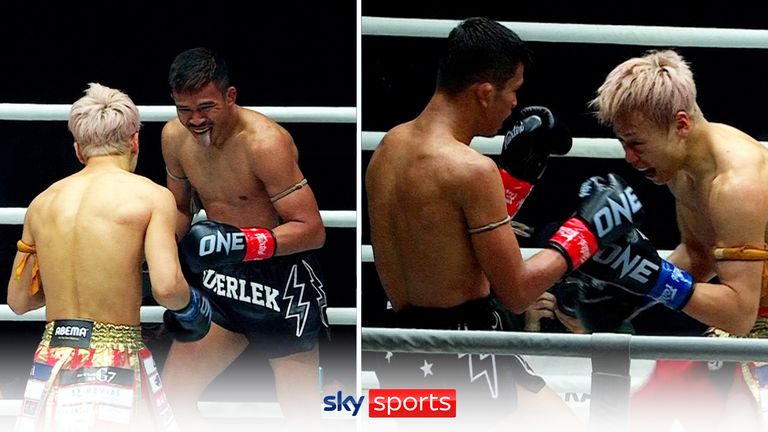
Thailand’s Superlek, known as “The Kicking Machine,” is the reigning ONE Championship flyweight kickboxing world champion. He is coming off a highly impressive performance when he defeated Japanese star Takeru Segawa over five rounds.

Last year he also beat another great of the sport, Rodtang Jitmmuangnon in an historic Muay Thai collision.

Please use Chrome browser for a more accessible video player

Superlek Kiatmoo9 retained his ONE flyweight kickboxing world title against Takeru Segawa in a fight packed with relentless action

But Haggerty is no stranger to toppling legends. A former flyweight champion, he is a two-weight world champion as well as being a current two-sport titlist.

Last year he spectacularly knocked out Nong-O Gaiyanghadao to win the Muay Thai bantamweight title before then stopping Fabrício Andrade to win the kickboxing crown too.

Most recently he came through a thriller when he beat Felipe Lobo in a Muay Thai championship defence, which he ultimately won inside the distance too.

Please use Chrome browser for a more accessible video player

Watch the moment ONE’s Jonathan Haggerty became a two-sport world champion after beating Fabricio Andrade

On the same card the ONE atomweight MMA world champion superstar Stamp Fairtex will challenge Xiong Jing Nan for the ONE strawweight MMA world title.

The first three-sport world champion in ONE history, Stamp will be looking to become a two-division titleholder and cement her legacy as one of the most decorated athletes in combat sports.

Get Sky Sports on WhatsApp!

You can now start receiving messages and alerts for the latest breaking sports news, analysis, in-depth features and videos from our dedicated WhatsApp channel!

Find out more here…

[ad_2]

Source link

Kremlin Treads Carefully After Moscow Attack Over Fears of Ethnic Strife

0

[ad_1]

At a memorial service this week outside the concert hall where Islamist extremists are suspected of carrying out a deadly terrorist attack, one of Russia’s most popular pro-Kremlin rappers warned “right-wing and far-right groups” that they must not “incite ethnic hatred.”

At a televised meeting about the attack, Russia’s top prosecutor, Igor Krasnov, pledged that his service was paying “special attention” to preventing “interethnic and interfaith conflicts.”

And when President Vladimir V. Putin made his first comments on the tragedy last weekend, he said he would not allow anyone to “sow the poisonous seeds of hatred, panic and discord in our multiethnic society.”

In the wake of the assault near Moscow that killed 139 people last Friday, there has been a recurring theme in the Kremlin’s response: a fear that the tragedy could spur ethnic strife inside Russia. While Mr. Putin and his security chiefs are accusing Ukraine — without evidence — of having helped organize the killing, the fact that the four detained suspects in the attack are from the predominantly Muslim Central Asian country of Tajikistan is stoking anti-migrant rhetoric online.

For Mr. Putin, the problem is magnified by the competing priorities of his war in Ukraine. Members of Muslim minority groups make up a significant share of the Russian soldiers fighting and dying. Migrants from Central Asia are providing much of the labor that keeps Russia’s economy running and its military supply chain humming.

But many of the most fervent supporters of Mr. Putin’s invasion are Russian nationalists whose popular, pro-war blogs on the Telegram messaging app have brimmed with xenophobia in the days since the attack.

“The borders have to be shut down as much as possible, if not closed,” said one. “The situation now has shown that Russian society is on the brink.”

As a result, the Kremlin is walking a fine line, trying to keep war supporters happy by promising tougher action against migrants while trying to prevent tensions from flaring across society. The potential for violence was highlighted in October, when an antisemitic mob stormed an airport in the predominantly Muslim Russian region of Dagestan to confront a passenger plane arriving from Israel.

“The authorities see this as a very big, serious threat,” Sergey Markov, a pro-Putin political analyst in Moscow and a former Kremlin adviser, said in a phone interview. “That’s why all efforts are being made now to calm down public opinion.”

Caught in the middle are millions of migrant workers and ethnic-minority Russians who are already facing an increase on city streets in the kind of racial profiling that was commonplace even before the attack. Svetlana Gannushkina, a longtime Russian human rights defender, said on Tuesday that she was scrambling to try to help a Tajik man who had just been detained because the police “are looking for Tajiks” and “saw a person with such an appearance.”

“They need migrants as cannon fodder” for the Russian Army “and as labor,” Ms. Gannushkina said in a phone interview from Moscow. “And when they need to fulfill the plan on fighting terrorism, they’ll also focus on this group” of Tajiks, she said.

Nearly a million citizens of Tajikistan, which has a population of about 10 million, were registered in Russia as migrant workers last year, according to government statistics. They are among the millions of migrant laborers in Russia from across the former Soviet republics of Central Asia, a driving force in Russia’s economy, from food delivery and construction to factory work.

A manager of a food business in Moscow that employs Tajiks said in an interview that the mood in the Russian capital reminded her of the 2000s, when Muslims from the Caucasus region faced widespread discrimination in the wake of terrorist attacks and the wars in Chechnya. Tajiks in Moscow are so apprehensive they are hardly going outside at all, she said, requesting anonymity because she feared repercussions for speaking to a Western journalist.

“There’s already no supply of labor because of the S.V.O.,” she added, using the common Russian abbreviation for the Kremlin’s “special military operation” against Ukraine. “And now it’ll be even worse.”

Ethnic tensions have been an enduring challenge for Mr. Putin during his almost quarter-century rule, but he has also tried to use them to his geopolitical advantage. Mr. Putin’s rise to power was shaped by war in the southern, predominantly Muslim region of Chechnya, where Russia sought to brutally extinguish separatist and extremist movements. He has also helped foment separatism in places like the Georgian regions of South Ossetia and Abkhazia, taking sides in long-simmering conflicts there to expand Russia’s influence.

Mr. Putin’s government is already trying to show the public that it stands ready to take action against migrants. A top lawmaker proposed on Tuesday that firearms sales be banned to newly naturalized Russian citizens. Mr. Krasnov, the top prosecutor, said that the number of crimes carried out by migrants rose by 75 percent in 2023, without providing specific details. “We need to develop balanced solutions based on the need to ensure the safety of citizens and the economic expediency of using foreign labor,” he added.

Far from trying to keep foreigners out, Russia has made it easier for migrants to become Russian citizens since the start of its full-scale invasion of Ukraine in February 2022. A primary reason appears to be the military’s need for soldiers in Ukraine, and police raids targeting migrant workers to compel them to register for military service have become commonplace in Russian news reports.

As a result, Tajik migrants in Moscow now fear not only deportation, but also the possibility that they could be pressed into service in Ukraine, said Saidanvar, 25, a Tajik human rights activist who recently left Moscow. He asked that his last name not be used for security reasons.

“Tajiks are really afraid,” he said in an interview, “that the Russian authorities will start sending Tajiks to the front en masse to fight as a sort of revenge against our Tajik people.”

In his speeches on the war, Mr. Putin has paid frequent lip service to Russia as a multiethnic state — a legacy of the Russian and Soviet empires. In March 2022, after describing the heroism of a soldier from Dagestan, Mr. Putin enumerated some of Russia’s ethnic groups by saying: “I am a Lak, I am a Dagestani, I am a Chechen, an Ingush, a Russian, a Tatar, a Jew, a Mordvin, an Ossetian.”

In his rhetoric about his conflict with the West, Mr. Putin has frequently accused Russia’s adversaries of trying to stir up ethnic strife in Russia. That was his response to the Dagestan airport riot in October, which he baselessly blamed on Western intelligence agencies and Ukraine. That is also increasingly at the center of his response to Friday’s terrorist attack, which the Islamic State claimed responsibility for and American officials say was carried out by a branch of the extremist group. On Tuesday, the head of Russia’s domestic intelligence agency claimed that Ukrainian, British and American spies might have been behind it.

The upshot appears to be that the Kremlin is seeking to refocus anger over the attack toward Ukraine while trying to show the public that it is taking concerns about migration into account.

“They’re going to grab the Tajiks and blame the Ukrainians,” Ms. Gannushkina, the human rights defender, said. “It was clear from the very beginning.”

Still, Mr. Markov, the pro-Kremlin analyst, said he saw tensions over migration policy even inside Mr. Putin’s powerful security establishment. Anti-immigrant law enforcement and intelligence officials, he said, were at odds with a military-industrial complex that needs migrant labor.

“It’s a contradiction,” he said. “And this terror attack has sharply aggravated this problem.”

[ad_2]

Source link

Why We Can't Stop Arguing Whether Trump Is a Fascist

0

[ad_1]


In a new book, Did it Happen Here?, scholars debate what the F-word conceals and what it reveals.

[ad_2]

Source link

Super League Rivals Round: Hull FC aim to turn around tough start in derby clash with Hull KR | Rugby League News

0

[ad_1]

Tony Smith could have been forgiven if he was left with a familiar feeling as Hull FC crashed out of the Betfred Challenge Cup away to Huddersfield Giants last Saturday afternoon.

The 50-6 defeat at the John Smith’s Stadium marked the second game in a row the Black and Whites had conceded a half-century of points and mirrored the dismal form they had shown during the first five games of the 2024 Betfred Super League season.

It does not get any easier for the return to league action which comes against bitter cross-city rivals Hull KR, having already lost 22-0 at home to them in the opening game of the season, on Good Friday and Hull FC head coach Smith acknowledged his team’s failings so far this year.

Please use Chrome browser for a more accessible video player

Highlights of the Super League match between Hull FC and Hull KR.

“We need to toughen up across the board, we need to make sure we are doing our own jobs and doing them really well,” Smith said in his post-match press conference at Huddersfield. “That’s taking responsibility for it, and we have got to do that.

“We know it’s not good enough, we need to get more determined and if that means we are not strong enough in a lot of facets in the game, physically and mentally, then so be it.

“We will need to dust ourselves and learn quickly. They are playing well and playing confidently, and we are at the other end of the realm at the moment.”

The contrast between the clubs from the east and the west of Kingston Upon Hull could hardly be more stark. Whereas FC remain mired in the bottom half of the table, finishing the 2023 season in 10th, KR are once again among the play-off contenders after reaching the semi-finals last year.

Hull KR and Hull FC in Super League in 2024

Statistical category Hull KR Hull FC
Won 3 1
Lost 2 4
Tries per game 3.8 2
Tries conceded per game 2.2 5.6
Net tries +1.6 -3.6
Points per game margin +7 -21.6
Metres per game 1,725 1,345
Metres per game margin +211 -465
Set completion % 78.4 75.6

The Robins are scoring nearly double the number of tries per game as the Black and Whites and have an average points per game margin of plus-seven points per game on their opponents so far compared to minus-21 for Smith’s side.

The PythagoPat expected wins measurement suggests Hull KR have been playing slightly better than results have shown in their first five Super League matches as well, calculating their expected record so far would be four wins and one loss as opposed to their actual record of three wins and two defeats.

Avenging one of those early-season losses with a 40-0 demolition of Salford Red Devils in their Challenge Cup sixth-round tie last Friday ensured the promising start for last season’s Wembley runners-up continued, but head coach Willie Peters is not allowing anyone to pat themselves on the back ahead of Friday’s derby.

“It’s all part of your growth,” Peter said after the win over the Red Devils. “For us now, we can either give ourselves pats on the back, there’s going to be some really happy fans which is great because that’s all part of our focus.

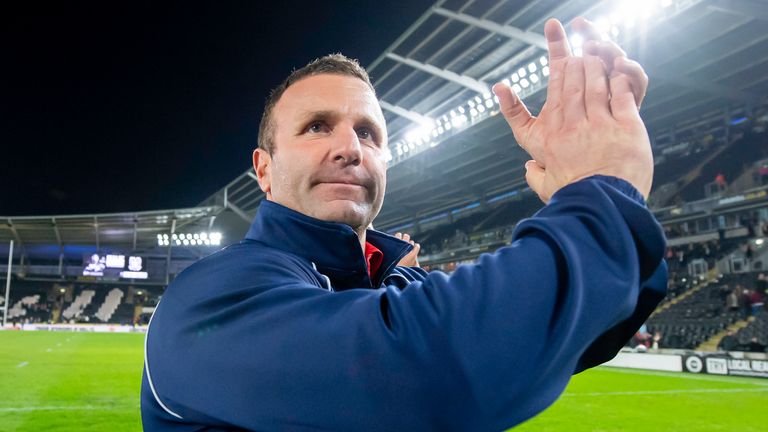
Picture by Allan McKenzie/SWpix.com - 15/02/2024 - Rugby League - Betfred Super League Round 1 - Hull FC v Hull KR - MKM Stadium, Kingston upon Hull, England - Hull KR's coach Willie Peters celebrates to the fans after his side's victory in the Hull derby over Hull FC.
Image:
Willie Peters celebrates Hull KR’s win over Hull FC in the opening game of the season

“But we can either listen to the fans and that makes you feel good, then you come into work on Monday still feeling good and then you’re at Wednesday and you’re playing in two days and you lose that focus and mental side of where we want to be as a team.

“I’d like to think we’re getting there where we won’t be doing that but there’s no doubt that you can fall into that – is weak mindset the right word? That complacent mindset, and that’s the challenge for us now.”

Hull FC’s only win so far in 2024 came in a 26-24 win at home to promoted London Broncos in Round 3 of the Super League season, although their struggles so far can be mitigated by the injuries and suspensions which have decimated the squad in February and March.

The Black and Whites were without nine players due to injury for the Challenge Cup defeat away to Huddersfield, but should at least have off-season recruit Franklin Pele, who was sent off in the first derby meeting of the year, and Jack Ashworth back from suspension for Friday.

Please use Chrome browser for a more accessible video player

Tempers boiled over during the opening game of the 2024 Betfred Super League season between Hull FC and Hull KR.

Smith, who spent just over two years in charge of Hull KR and crossed the city’s rugby league divide ahead of last season, knows his side are underdogs for the clash at Sewell Group Craven Park and hopes they can embrace that mentality for what would be the perfect game to get back to winning ways in.

“That’s sometimes where you see spirit, determination and people dig in,” Smith said. “Sometimes being written off can be a good thing.

“I know there will be a lot of people writing us off this week and probably rightfully so after those two performances.

“We’ll see what we can do about it, but when you get it right and you turn things around, it’s quite sweet. We’ve got a bit of work to do before we get to that stage.”

Watch every match of the 2024 Betfred Super League season, including Rivals Round, Magic Weekend, the play-offs, and men’s, women’s and wheelchair Grand Finals, live on Sky Sports. Also stream with NOW.

[ad_2]

Source link
Are Spit Hoods Safe? Police Keep Using Them Despite Deaths

0

[ad_1]

When Tim Peters started banging on a neighbor’s door and shouting about religion just before sunrise with a beer bottle in his hand, someone called the county sheriff. Neither the deputies nor Peters’ wife, Julie, could get him to calm down.

He ended up in the medical unit at the Hernando County jail north of Tampa in April 2022. Video from his cell showed the 49-year-old handyman struggling with deputies. They pepper sprayed him. Then they covered his face with a mesh bag known as a spit hood. When it became soaked with saliva and blood, they added another one. Minutes later, Peters was motionless in a wheelchair.

Jail staff spent nearly three minutes pumping on his chest to revive him before they took the bags off of his head. He died at a hospital the next day. A medical examiner noted the use of the spit hoods in her report but concluded that the cause of death was undetermined.

“He was my best friend, and I was his,” Julie Peters said. “The person in that video, that was not the Tim I know.”

Spit hoods, also called masks, socks or nets, briefly became part of the national debate about police use of force in 2020, when 41-year-old Daniel Prude suffocated after police in Rochester, New York, forced a hood on him because he claimed to have COVID and spat in their direction.

A few police departments, like the one in Tucson, Arizona, have since stopped using the restraints. But many have not — and the deaths have continued. Police used spit hoods on at least 31 people who died in their custody between 2013 and 2023, according to an investigation by The Marshall Project and WTSP, the CBS affiliate in Tampa.

There are no national reporting requirements on deaths involving spit hoods. And most departments that give patrol officers the masks don’t track how often they are used. Many departments have no policies on deploying the device — and among the ones who do, the rules vary wildly. The Polk County Sheriff’s Office, southwest of Orlando, said it doesn’t have a policy, and that spit hoods “are used when it makes common sense.”

Police used spit hoods on at least 31 people who died in their custody in a decade, according to an investigation by The Marshall Project and WTSP.

In most of the deaths the news organizations analyzed, medical examiners said they couldn’t determine how people died, or they cited other causes, like drug overdoses. The Marshall Project and WTSP found at least five cases where coroners mentioned spit hoods as a possible cause or contributing factor in fatalities.

“One death is too many,” said George Kirkham, a Florida State University criminology professor who is an expert in police use of force. “We can say more people die from shootings or beatings, but the families of these folks are devastated just the same.”

Mentions of spit hoods in deaths involving police can remain hidden from public view for months or forever. Sheriff’s officials in Florida did not initially tell the public that they placed two hoods on Peters. They revealed it only after WTSP reporters pressed the agency for more details and eventually obtained an unredacted 21-minute video of Peters’ death.

Many police departments include spit hoods in their use of force policies and consider them restraints. But other police chiefs and law enforcement leaders have characterized spit socks as sanitary devices. The hoods keep people from spitting on officers and save them from potential health risks from contact with saliva. In fact, healthcare workers also use the nets to keep patients from spitting on them in places like hospitals, ambulances and nursing homes.

“Proper use (i.e., application, general wearing, and removal) of the spit hood is not, in and of itself, a use of force,” former DC Metropolitan Police Chief Robert Contee wrote about his agency’s spit hood policy in September 2022.

A man in orange prison shorts is being restrained by three officers in a prison cell.

Some research studies have shown that even dense spit hoods are easier to breathe in than an N95 mask, and study subjects could breathe even in hoods sprayed with artificial saliva. But critics say none of those studies mimicked the chaos and stress of being arrested or held in jail.

Still, sheriff’s deputies in Hernando County cited one of those studies, by researchers at the University of California in San Diego, in defending their actions in Peters’ death.

In a press conference last fall, Hernando County Sheriff Al Nienhuis said Peters fought deputies who tried to restrain him, and that they put a second spit sock on Peters because the first one had become wet. Spokesperson Denise Moloney told The Marshall Project she couldn’t comment extensively but said deputies left the hoods on Peters when they started CPR because their immediate priority was to revive him.

“We did everything in our power to help him,” Moloney said. “We don’t believe the spit hood was the source of the issues he had.”

The officers were not charged with any wrongdoing.

A month after Peters’ death, 47-year-old Dee Dee Hall ran from Dallas police, who responded to a call that she was creating a disturbance. Hall yelled incoherently and threw herself on the ground when officers detained her, police body cam video shows. A medic put a spit mask on her, and she continued to yell as they wheeled her into an ambulance. Then she fell silent.

The video shows Hall lying still while two people in the ambulance begged her to say something. They took the hood off of her head and tried to revive her. Doctors at a Dallas hospital declared her dead, according to a Texas attorney general’s report. A medical examiner ruled her death a drug overdose.

In March 2023, a grand jury declined to indict the officers and medical workers involved in her arrest. Dallas Police declined to comment.

Opponents of police use of spit nets say deaths like Hall’s and Peters’ challenge the findings of the controlled lab experiments that have found spit hoods safe.

Dallas police responded to a 911 call that Dee Dee Hall was causing a disturbance on May 26, 2022. While she was being detained, Dallas Fire-Rescue staff placed a spit hood over Hall’s head before transporting her to a hospital.

Until the University of California study last year, all the research that involved humans tested people’s ability to breathe under dry hoods. And even the artificial saliva the researchers used was thinner than real human spit, some experts say.

Dr. Dan Woodard said he believes that’s one reason the studies are faulty. A former emergency room physician, Woodard testified in 2018 as an expert witness in the case of a Florida man who died in police custody under a spit restraint. Woodard has been studying the effects of spit hoods ever since.

People restrained in masks during police encounters can spit up vomit or blood, which also have a thicker consistency than the liquid used in the study, Woodard said in an interview.

“Plus, these are people who are in a controlled environment,” Woodard said of the studies. “They haven’t just finished running from the police or getting punched or hit or thrown to the ground.”

People who have tried to breathe in spit masks during police encounters describe it as a scary experience.

Nzinga Bayano Amani had several encounters with law enforcement in Knoxville, Tennessee, as a civil rights activist before 2022. But it was only after officers served Amani with an arrest warrant in the middle of a city council meeting that year that Amani found out what it was like to be in a hood.

Amani, who is now suing the Knoxville Police Department and the Knox County Sheriff’s Office for the encounter, said officers misplaced the elastic band of the spit hood that is supposed to go around the neck, and Amani struggled to breathe after the band was caught in their mouth. Amani was able to take deep breaths through their nose to avoid losing consciousness, they said.

A Black person speaks into a courtroom microphone while sitting at a witness stand.

“I knew if at any time I got any more stressed or agitated, there’s a possibility I could have passed out,” Amani said.

The sheriff’s office and police department declined to comment, citing the lawsuit. In their response to Amani’s complaint, the agencies said officers acted reasonably.

In more than half of the 31 deaths involving spit hoods that The Marshall Project and WTSP compiled, police agencies used the hood in conjunction with other restraint techniques or tactical weapons, including hog-tying, pepper spray and stun guns.

Medical experts say that these combinations often worsen the problems that lead to serious injury or death.

In the murder trial last fall of three Tacoma, Washington, police officers involved in the 2020 death of 33-year-old Manuel Ellis, most of the testimony centered on the officers beating and tasering Ellis before forcing him to lie face down on the pavement as some of them knelt on his back.

A fourth officer, who placed a spit hood over Ellis’ head during the confrontation, never faced any criminal charges and was cleared of any wrongdoing.

A medical examiner ruled Ellis died of a lack of oxygen from the officers applying pressure to his back, and mentioned the spit hood as another factor. Dr. Roger Mitchell, a forensic pathologist who testified during the trial, also listed the spit hood as a possible contributing cause of Ellis’ death.

Mitchell testified that he examined the spit hood police used on Ellis and found blood and mucus caked on the mesh.

“Any time that I would see a spit hood with blood, then I would worry that he would be at risk of aspirating blood or breathing in fluid or blood that is being gathered in the spit hood,” Mitchell testified.

The officers said the force they used was necessary, and a jury in December acquitted them of all charges. Tacoma Police referred The Marshall Project to a statement from Chief Avery Moore and said the department is revamping its use of force policy, including spit hoods.

Ellis’ case also highlights another major issue related to spit hoods: Many police departments lack rules dictating when and how officers should use them. At the time of Ellis’ death, Tacoma Police had no policy on the use of the spit restraints.

In other fatal cases, like that of Jose Albert Lizarraga Garcia in Indio, California, police agencies did have policies, and have not changed them since the death. Indio Police Officer Benjamin Guitron told The Marshall Project last month that an internal review concluded that officers followed department policy in Garcia’s case. Court records show the department settled a wrongful death lawsuit with Garcia’s family last year.

Among departments with spit hood policies, most require officers to remove the sacks when a person is vomiting, bleeding from the mouth or suffering from other medical conditions, according to The Marshall Project’s review of policies from 100 departments in 25 states.

But only 10 of those departments restrict spit hoods to cases in which someone is actively spitting or biting others, or is about to do so. Only 11 require officers to warn people before putting them in a spit mask. And only 12 policies point out that people in a mental health crisis can experience high distress when in a spit net.

The Record

The best criminal justice reporting from around the web, organized by subject

A lack of both national standards and clinical studies that mirror real-world conditions leaves many departments making up their policies as they go along, according to Roy Bedard, who has studied the effects of stress on decision-making in police encounters.

“Society, unfortunately, has become somewhat of a living laboratory,” Bedard said.

The U.S. Department of Justice has noted officers’ improper usage of spit restraints in investigations of police misconduct. A 2014 civil rights investigation into the Cleveland Division of Police cited the arrest of a man whom officers placed in a hood and then pepper sprayed through the mask. The federal report said this was “cruel” and “unnecessary punishment” that “was not even questioned by the chain of command.”

Most makers of spit hood devices say they sell them with clear instructions, noting that the manufacturers cannot be held liable for any injuries if the bags are used improperly.

Those guidelines generally say officers should never leave spit hoods on for more than several minutes at a time, and never leave the person unattended. They also warn against using the devices on people who are bleeding heavily from the mouth or are vomiting, or who appear to be in a mental health crisis.

Tranzport Products, the maker of the Tranzport Hood, says the company urges police agencies to train officers on how to use the hood. John Cominsky, the product’s inventor, said in an interview that the idea for the device came to him while watching television footage of protesters spitting on police and veterans after the Vietnam War.

Cominsky said growing sales attest to the need for the hoods. Although he said he would welcome national guidelines or policies regarding spit mask use, Cominsky said the only instructions police officers need for his product are the ones he provides.

“Anything can be misused,” he said. But he said his mask, which has an opening in the front below the person’s chin, is “safe for the officer and the person in it when used properly.”

The caveat of proper usage is one that some medical experts have recognized as well. In the 2015 death of Ben C de Baca in police custody in Bernalillo, New Mexico, a medical examiner ultimately attributed de Baca’s death to cocaine intoxication, but listed suffocation from the physical restraint as a contributing factor.

“If improperly placed, spit shields also have the potential to impair breathing by suffocation,” Dr. Ian Paul wrote in de Baca’s report.

De Baca’s family settled a wrongful death suit against Bernalillo Police in 2019 for an undisclosed amount. In a court filing, the officers denied any wrongdoing.

Life Inside

Essays by people in prison and others who have experience with the criminal justice system

In the United States, the use of masks goes back to before the Civil War, when historians say slave owners placed enslaved people in locked hoods to intentionally make it harder for them to breathe or eat as punishment.

The first reports of people spitting on police officers as an act of protest go back more than a century, according to a Forensic Science International journal report. Some departments used spit masks during the early days of the AIDS epidemic in the 1980s, when officers erroneously feared that they could contract the illness if a person with HIV spat on them.

More recently, at the start of the COVID pandemic, some police chiefs and union leaders warned against people trying to transmit the disease by spitting on officers.

“Recent cases have shown examples of individuals spitting and coughing at law enforcement officers’ faces to intimidate them,” a March 2020 Interpol report said. “This could represent a risk if these individuals are infected by COVID-19.”

By the summer of that year, epidemiologists made it clear that COVID was an airborne disease, which meant the mesh spit hoods police officers use couldn’t stop its spread.

In the aftermath of Prude’s death in New York state, human rights groups like Amnesty International called for an end to the use of spit hoods. Prude’s family compared his death to lynchings in the Jim Crow era.

Edwin Budge, a Seattle-based lawyer who has successfully sued police in cases where people have been killed or injured in encounters that involved spit hoods, says he understands the need for some device to keep police safe from people who spit on them.

In some controlled environments, like transporting an incarcerated person to and from court, Budge said, police can expect a spit mask to perform as safely as it does in controlled studies. The problem is that officers fail to recognize that spit hoods can be deadly if they use them incorrectly.

“They have to be used really cautiously in the field,” Budge said. “Rule number one is that you shouldn’t ever impair anyone’s ability to breathe.”

Nearly two years after Peters’ death, his wife said she can still hear him laugh sometimes. The husband she remembers was as witty as he was gentle, an animal lover who liked to play the guitar and serenade her with renditions of John Legend’s “All of Me.”

She doesn’t know what led to his behavior the morning he was arrested, Julie Peters said. She thought he may have been suffering from a psychological breakdown, though she said he had never been diagnosed with a mental illness. She remembers the moment sometime after the arrest, when an officer confirmed that her husband was at the jail.

“Oh, thank God,” she thought. “He’s safe.”

Two days later, he was dead.

[ad_2]

Source link

Popular Posts

My Favorites